
Nine organizations completed the inaugural gener8tor Skills AI for Leaders cohort, exploring practical applications of artificial intelligence to improve operations, strengthen workforce development, and solve everyday business challenges.
Artificial intelligence, or “AI”, often dominates headlines, but for organizations across Southern Virginia, the most important question is not what AI might do someday. It is what AI can do today.
This spring, leaders from nine Southern Virginia companies participated in the inaugural gener8tor Skills AI for Leaders cohort, a six-week program designed to help employers identify practical opportunities to apply artificial intelligence within their operations. Supported by Microsoft and the SOVA Innovation Hub, the virtual cohort brought together participants from Southern Virginia alongside peers from Wisconsin and Minnesota to explore real-world applications of AI across manufacturing, logistics, operations, workforce development, and business services.
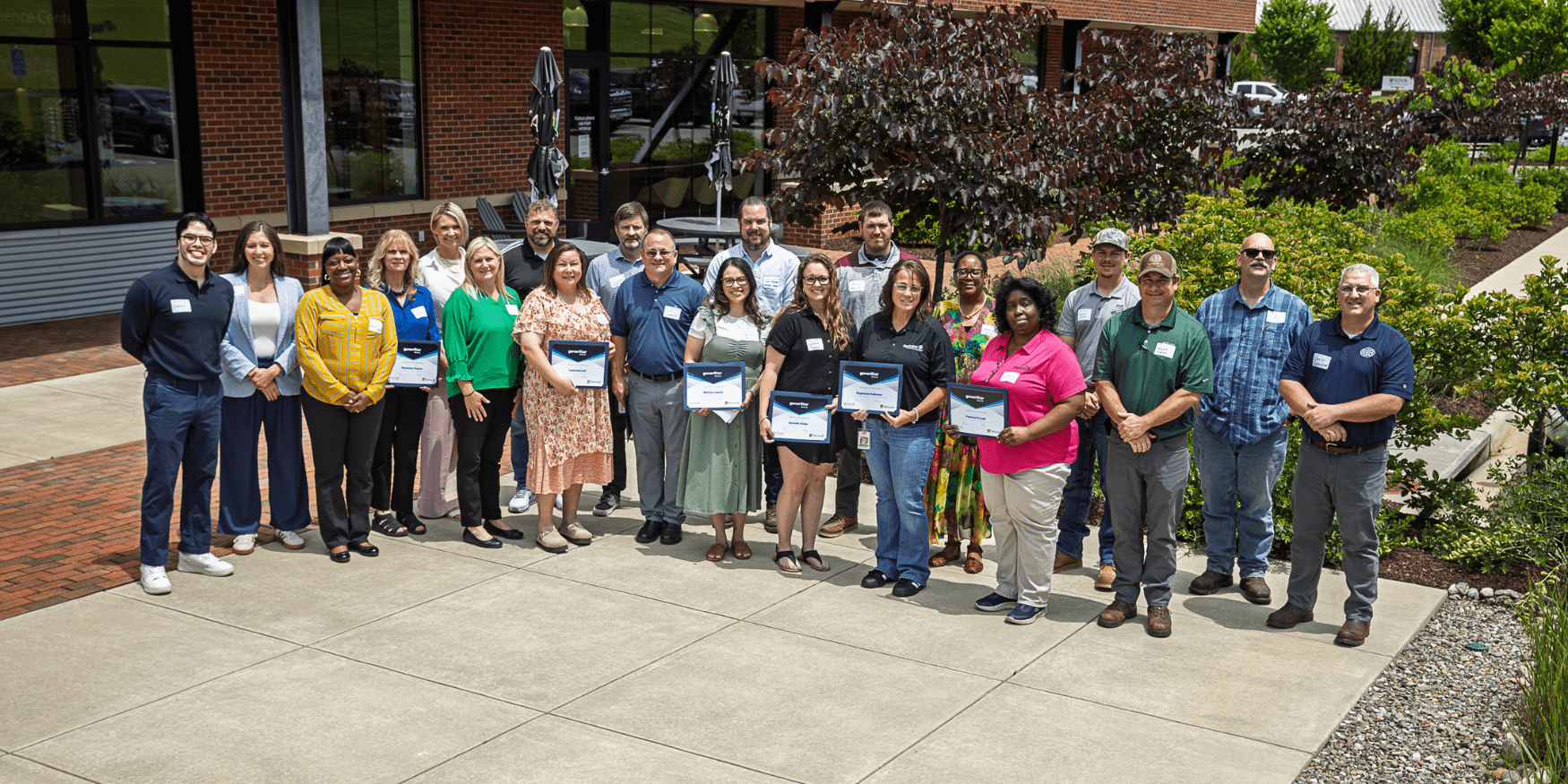
On June 2, Southern Virginia participants gathered at the SOVA Innovation Hub for an in-person networking event, certificate presentation, and showcase of projects developed during the cohort. Participants shared lessons learned, discussed implementation strategies, and celebrated the completion of the program.
Participating Companies
Participating Southern Virginia organizations included AJ Transport, Beyond Freight LLC, Dedon & Gloster Furniture, Dollar General, Genesis Products, Huber Engineered Woods, the Institute for Advanced Learning and Research (IALR), Morgan Lumber Co., and Reynolds Consumer Products (Presto Products Company). Four organizations presented AI use cases developed during the cohort, while all participants engaged in hands-on learning, peer collaboration, and exploration of practical AI applications within their operations.
The AI use case projects varied widely, but a common lesson emerged: Successful AI adoption is not about replacing people. It is about helping employees solve problems faster, make better decisions, preserve valuable knowledge, and work more effectively.
The goal of gener8tor Skills AI for Leaders is not simply to teach organizations about artificial intelligence. It is to help them identify practical opportunities to create value within their operations. What stood out about this cohort was the focus on solving real business challenges, from quality control and workforce training to logistics and knowledge management. These projects show that organizations do not need to start with large-scale transformation. They can begin with a specific challenge and build from there.
One of the most exciting outcomes of this cohort was seeing participants move beyond talking about AI and begin applying it to real business challenges. The projects presented were not theoretical. They focused on improving quality, preserving institutional knowledge, streamlining operations, and supporting employees in their day-to-day work. That is exactly the type of practical innovation we want to see happening across Southern Virginia.
AI Use Cases
Four participating organizations presented projects focused on quality control, workforce training, logistics, and knowledge management. Together, they demonstrated how organizations can begin using AI to address practical business challenges without large technology teams or significant technology investments.
Huber Engineered Woods: Predicting Quality Issues Before They Become Problems
The project presented by Huber Engineered Woods focused on a challenge familiar to many industrial operations: identifying quality issues before they lead to defects, waste, or production disruptions.
Using historical production data, the team developed a machine learning model designed to recognize patterns associated with successful and unsuccessful production outcomes. The project combines historical production data, supervised learning, and AI-assisted recommendations to help identify root causes of quality issues and flag when processes may be trending toward undesirable outcomes.
The team emphasized that data quality is just as important as model quality.
“Just because it’s data doesn’t mean it’s good data,” one presenter explained, noting the importance of filtering out downtime events, outages, and unusual operating conditions that could distort results.
The project also reinforced an important principle shared throughout the cohort. AI should support human expertise, not replace it. While the model provides recommendations and early warnings, operators remain responsible for evaluating the information and making final decisions.
For the organization, the biggest immediate benefit is speed. Analyses that once required days of manual effort can now be completed in near real time, allowing teams to respond faster and make more informed decisions.
The project has progressed beyond experimentation and is preparing for controlled production testing to evaluate prediction accuracy, operator adoption, and overall performance.
Reynolds Consumer Products: Modernizing Training and Capturing Operational Knowledge
The team from Reynolds Consumer Products’ South Boston facility explored how AI could help address one of the most time-consuming challenges in manufacturing: creating and maintaining training documentation.
Developing a single standard work document often requires dozens of hours spread over several weeks as trainers, supervisors, process specialists, and operators collaborate to document procedures. By the time documentation is complete, equipment changes or process improvements may already require revisions.
The result is often a gap between documented procedures and actual operations.
The team’s AI use case focused on accelerating the creation and maintenance of standard work documents while capturing valuable institutional knowledge held by experienced employees.
Their goal is to reduce documentation bottlenecks, improve onboarding, strengthen training consistency, and preserve expertise that might otherwise be lost through workforce transitions.
For many manufacturers facing retirements and workforce challenges, ensuring that critical knowledge remains accessible may prove just as valuable as improving operational efficiency.
Dedon & Gloster Furniture: Turning Five Freight Tools into One
Representatives from Dedon and Gloster, two outdoor furniture brands operating under one umbrella, tackled a challenge that affected both employees and customers: freight calculations.
As the organizations became more integrated, freight quotes continued to be generated through multiple tools, by numerous employees, across two brands. The result was inconsistent information, internal inefficiencies, and delays in responding to customer requests.
One example highlighted the challenge. A sales representative on the West Coast might be working to close a significant order after the East Coast freight team had already left for the day. Without access to reliable freight calculations, the sale would have to wait.
To address the issue, the team used ChatGPT as a collaborative design partner, consolidating freight maps, spreadsheets, and standard operating procedures into a single freight calculator.
“I used ChatGPT like a business partner,” one team member shared. “We went back and forth 39 times before we had a version that actually worked.”
The resulting tool standardizes freight logic across brands, simplifies the user experience, and provides faster, more consistent quotes regardless of time zone.
The project also underscored an important lesson about AI implementation.
“Garbage in, garbage out. You have to test it, validate it, and make sure what you’re getting out is accurate.”
The team plans to seek executive approval and begin implementation across customer service, sales, and warehouse operations.
Morgan Lumber: Preserving Knowledge Before It Walks Out the Door
For Morgan Lumber Group, a deck board manufacturer in Charlotte County, the challenge was knowledge management.
Critical operational knowledge existed in multiple places: vendor emails, maintenance records, manuals, blueprints, and the memories of employees with decades of experience.
“Every time we lose an employee, we lose a lot,” one presenter explained. “Once they retire, everything they know is gone.”
The company is developing a secure, internally hosted knowledge system that will allow employees to quickly search vendor communications, manuals, operating procedures, maintenance history, and troubleshooting records.
Instead of spending valuable time searching through binders, inboxes, and disconnected files, technicians would be able to ask simple questions such as, “Have we seen this fault before?” or “What fixed this issue last year?” and quickly locate relevant information.
One example demonstrated the potential impact. A recurring equipment fault that previously required 45 minutes of investigation could eventually surface related emails, manual pages, maintenance photos, and prior solutions in seconds.
The project will be implemented in phases, beginning with vendor communications and service records before expanding to manuals, blueprints, standard operating procedures, and institutional knowledge capture.
The team stressed that ease of use will determine success.
“Whatever we do, it has to be simple and easy to use. If they have to click through a bunch of screens and still can’t find what they need, they’ll stop using it.”
While the projects addressed different business challenges, several themes emerged throughout the cohort.
First, successful AI initiatives begin with clearly defined operational problems rather than technology itself.
Second, security and governance matter. Participants emphasized the importance of working within organizational policies and leveraging secure platforms that align with existing cybersecurity, privacy, and compliance requirements.
Third, AI is proving to be a powerful tool for preserving institutional knowledge. Across multiple projects, participants identified the loss of experienced employees and undocumented expertise as one of the most significant risks facing organizations today.
Finally, every team viewed AI as a tool that enhances human decision-making rather than replacing it. The most successful applications focused on helping employees work more efficiently, access information more quickly, and make better-informed decisions.
One participant reflected on the importance of continuing to learn and adapt:
“I hope I never get so old that I stop learning. I’m not the future of the company, but I have to map out a succession plan. I’m going to use AI to help me overcome some of my weaknesses and develop training plans, so when I do retire, that knowledge isn’t lost.”
While each organization entered the program with different goals and challenges, all demonstrated a commitment to exploring how emerging technologies can strengthen operations, support employees, and create value within their organizations. The cohort provided a unique opportunity for participants to learn from one another, share ideas across industries, and begin building a regional community of practice around artificial intelligence and innovation.
Building Southern Virginia’s AI Capacity
The first gener8tor Skills AI for Leaders cohort demonstrated that organizations do not need large technology budgets or dedicated data science teams to begin exploring AI.
The most promising opportunities often start with practical business challenges:
-
- Improving quality and reducing defects
- Preserving institutional knowledge
- Streamlining training and onboarding
- Simplifying complex operational decisions
- Improving customer service and responsiveness
Artificial intelligence presents tremendous opportunities for organizations of all sizes, but success starts with access, education, and hands-on experience. Through collaborations like this one with the SOVA Innovation Hub and gener8tor, we are helping employers explore practical applications of AI that can strengthen operations, support their workforce, and position them for future growth.
What stands out about these projects is that they began with real business needs. Whether improving operational efficiency, preserving decades of institutional knowledge, or helping employees access information more quickly, these organizations are demonstrating how AI can create meaningful value today. We are proud to support efforts that help build innovation capacity across Southern Virginia.
What’s Next for AI Training in Southern Virginia?
The SOVA Innovation Hub will continue working with Microsoft, gener8tor, employers, educators, and other regional partners to build Southern Virginia’s capacity for practical, human-centered AI adoption.
Beginning in early fall 2026, the SOVA Innovation Hub will launch additional opportunities for businesses, nonprofits, educators, students, local governments, and community members to engage with artificial intelligence through the SOVA AI Connect Workshop Series and the AI Civic Innovation Challenge.
These initiatives will provide hands-on learning opportunities, practical use cases, collaborative problem-solving experiences, and pathways for organizations to explore how AI can be used responsibly to address business and community challenges.
To stay informed about future AI workshops, cohorts, innovation challenges, and other technology-focused opportunities, follow the SOVA Innovation Hub on social media, subscribe to the Hub newsletter, or visit sovainnovationhub.com/ai-programs >